
BENNY ANDREWS: NO MORE GAMES
BY ANDREA BRIGHT
“In the poetics of struggle and lived experience, in the utterances of ordinary folk, in the cultural products of social movements, in the reflections of activists, we discover the many different cognitive maps of the future, of the world not yet born.” - Robin Kelley, Freedom Dreams
“A lot of things are done out of frustration, mostly bad, but one can't be deterred by the averages, so I shall write about our battle. Maybe I wouldn't use the language a more experienced writer would use in this situation, but I'll sure as to hell have the feeling for the damn subject." - Benny Andrews, “The Damn Article”
In the winter of 1970, Benny Andrews was at the forefront of a generational effort to diversify world-renowned museums such as The Whitney Museum of American Art and the Metropolitan Museum of Art (the Met). In the midst of this battle, Andrews painted No More Games, which dissects subjects like national pride, racial inequality, institutional power structures, and the American Dream. Andrews’s advocacy for Black voices in the arts and the broader American culture remains resonant today.

Benny Andrews, No More Games, 1970. Oil on canvas with cut-and-pasted primed and raw canvas, T-shirt, garment fragments, and partially painted printed fabrics, overall 100 7/8 x 101 ¼ in. Collection of the Museum of Modern Art, New York, NY
No More Games comprises two panels and stands at 8.4 ft tall and 8.4 ft wide, featuring mixed media elements. There are two figures, one on each side of the painting. The figure on the left is a young Black male seated with an empty look in his eyes. His posture is slouched and it appears as if he’s holding something, yet his hands are empty. His shadow is elongated because of the bright sun above him in the background. The second figure lays sprawled on the ground, draped in the American flag, with only the figure’s limbs exposed. The flag spills into the background like a star spangled sea. A phallic structure pierces the flag, a reoccurring symbol in Andrews work suggesting the prevalence of sexism. In conversation with one another, these figures appear to draw from the intersectionality of the Black American experience and the enervation this cross-cultural relationship has caused for centuries. No More Games is an expression of fatigue and a call for change. The issues of cultural representation Andrews worked to fight against still exist today which, in turn, begs the question: “Where does one draw the line?”
As a Black man in America and an activist, Andrews experienced racial discrimination throughout his life. In 1969 he co-founded he Black Emergency Cultural Coalition to protest against the Met’s Harlem on My Mind exhibition, which centered on the creative legacy of Harlem, New York, while omitting Harlem-based artists from the show. From 1969 through early 1971, he led negotiations with the Whitney Museum advocating for greater inclusion of Black artists and curators and eventually a boycott and picket in protest against this lack of representation; No More Games was made in the midst of this whirlwind of events. The title of the painting reinforces its visual metaphor; it draws a line in the sand, visually implying the end of the oppressive discrimination that had plagued many of Andrews’s experiences while living in a racist society and fighting for change within racist institutions. After examining Benny Andrews’ archive, I discovered more about this period of time in his life and how it significantly affected the way he produced allegory in his pieces.
PHOTOGRAPHS of BENNY ANDREWS and NO MORE GAMES - 1970.
Up close and personal, Rudolph “Rudy” Robinson captured a series of photographs of Benny Andrews in the midst of his creative process in his Manhattan studio. Andrews is seated on the floor in close proximity with the canvas; he carefully paints in small sections with intense intention to detail.
The series of photographs show the unfinished state of No More Games, with Andrews, surrounded by paint, fabric, and other art-making tools, intuitively selecting elements to add to the piece. In many of the photos he sits calmly and quietly mixing paint or contemplating his next steps to craft the ideal visual narrative. In the second photograph he paints a piece of cut fabric and in the first we can see Andrews pasting that same fabric piece onto canvas. The unique document puts us in the moment of the work’s creation and, with a handwritten date, lets us know the work was being made in December of 1970.


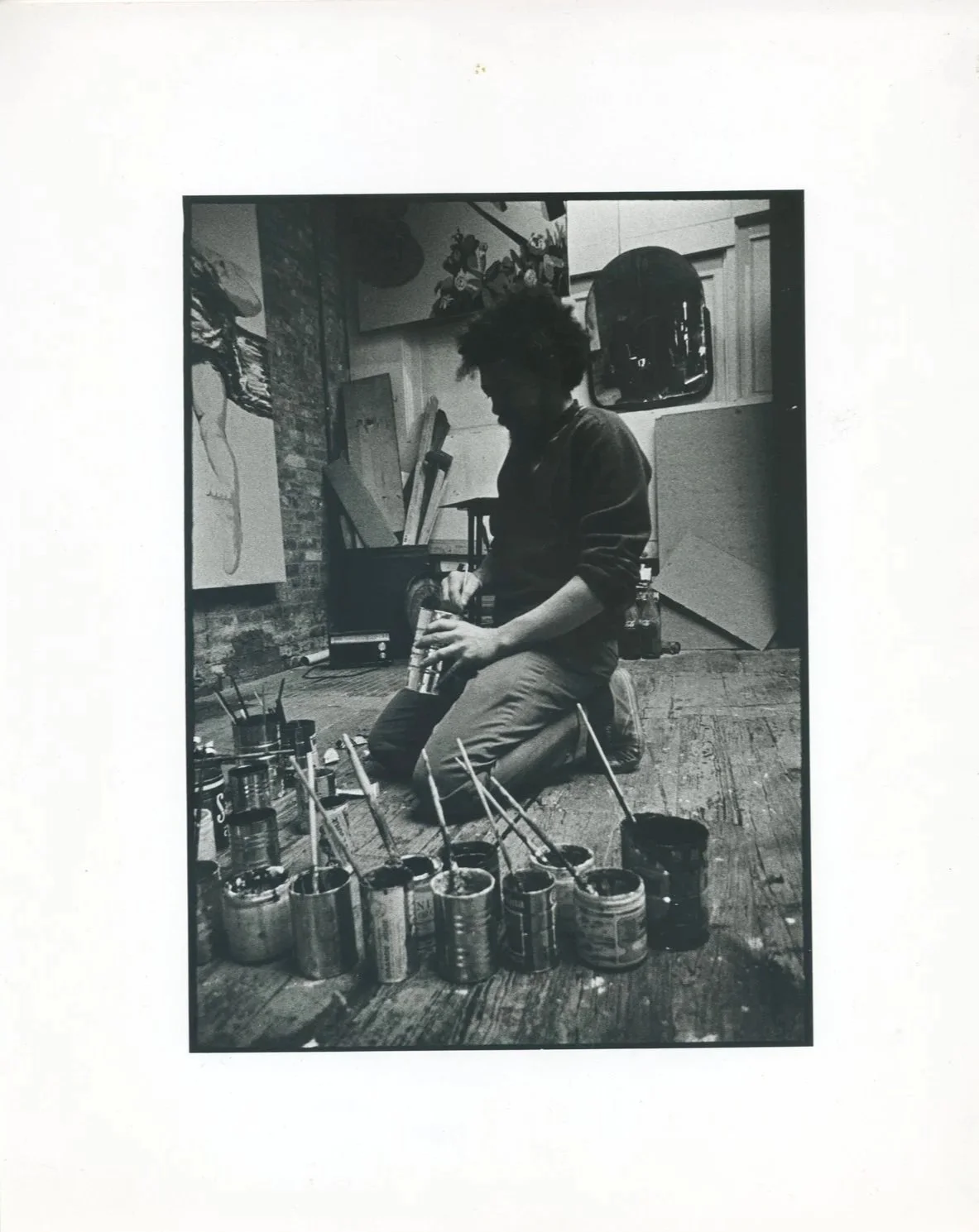


RUDOLPH “RUDY” ROBINSON, Untitled series of photographs of Benny Andrews working on no more games in Andrews’s Beekman St. Studio, New York, NY, December 1970
STUDIES IN PEN AND INK
Benny Andrews, No More Games (Study #3), 1970, ink and pencil on paper, 18 x 24 in, Collection of the Museum of Modern Art, New York, NY. (Inscription on recto: “Benny Andrews / Dec 1 1970”)
This series of drawn studies illustrates Andrews’ process of exploring surreal and symbolic imagery. We see the evolution of the image that later becomes No More Games. Andrews explores the positioning of the figures and which elements to include or remove to produce a concise message with minimal symbolic elements. His studies are done with pen and ink in an astonishing demonstration of skill. He then created large paintings from the drawings that fit his standards. Andrews would go through this process of redrawing and rearranging numerous times until the composition achieved his ideal vision. Through these studies, he kept some of the figures and symbols that didn’t make it into the final product to reuse in future projects.

Benny Andrews, No More Games (Study # 1), 1970, ink and pencil on paper, 24 x 18 in, Collection of the Museum of Modern Art, New York, NY. (Inscription on recto: “Dec 2 / 1970 Benny Andrews”)

Benny Andrews, No More Games (Study # 5), 1970, ink and pencil on paper, 24 x 18 in, Collection of the Museum of Modern Art, New York, NY. (Inscription on recto: “Benny Andrews / Dec 2, 1970”)

Benny Andrews, No More Games (Study # 6), 1970, ink and pencil on paper, 24 x 18 in, Collection of the Museum of Modern Art, New York, NY. (Inscription on recto: “Benny Andrews / Dec 1, 1970”)

Benny Andrews, Black Athlete (Study #1), 1970, ink and pencil on paper, 24 x 18 in, Collection of the Museum of Modern Art, New York, NY. (Inscription on recto: “Benny Andrews / Dec 2, 1970”)

Benny Andrews, Teaser (Black Athlete study #2), 1970, ink and pencil on paper, 24 x 18 in, Collection of the Museum of Modern Art, New York, NY. (Inscription on recto: “Benny Andrews / Dec 2, 1970”)

Benny Andrews, Study for No More Games, 1970, Oil and Fabric on canvas, 37 ¾ x 74 in, Collection of the High Museum, Atlanta, GA.

Benny Andrews, The Ball Game (No More Games Study #7), 1970, Ink and pencil on paper, 18 x 24 in, Collection of the Museum of Modern Art, New York, NY
Andrews’ meticulous methods reflect how he worked to find the best way to shape the visual narrative he aimed to create. These two studies, one drawing and one painting, of No More Games, are far from the final version of the painting we know today. But these early studies show how Andrews was slowly but surely finding the best elements to represent his message with clarity.
THE BLACK EMERGENCY CULTURAL COALITION and CONFLICT WITH THE WHITNEY
The Black Emergency Cultural Coalition (BECC) was founded by Andrews, along with fellow artists like Henri Ghent and Ed Taylor in reaction to the Met’s controversial Harlem On My Mind exhibition in 1969. Harlem On My Mind discussed the artistic culture of Harlem, a historically Black area of New York, but the Met omitted Black artists and curators from the exhibition’s development, research and subject matter, resulting in inaccurate portrayals of life in Harlem that many Black Harlem residents and artists took offense to. In response to Harlem On My Mind, the BECC was founded to hold museums accountable and advocate for more opportunities for Black artists and curators to have the ability to tell their own stories.
The BECC’s efforts led to protests, rebuttal exhibitions, as well as in-person and mailed negotiations with museum administrations, press conferences, and community programs. The BECC negotiated with the Whitney to have proper representation of Black American art, which resulted in the Whitney’s Contemporary Black Artists in America exhibition in 1971.
The issue of Black art wasn’t simply about museum acquisitions, but gaining a seat at the table; the BECC fought relentlessly for the voice of the Black community to be heard. The Whitney’s Contemporary Black Artists in America exhibition in 1971 was intended to illuminate the work of notable Black artists with the counsel of Black curators, though the Whitney fell short of their promise. Andrews, on behalf of the BECC, tirelessly made phone calls to each artist and guest to be featured in the show, requesting them to back out and protest against the Whitney for misleading the BECC during the development of the show. This effort was no easy feat, not every artist agreed with the BECC’s standing, and some vehemently refused. The BECC staged their Rebuttal Exhibition at the Acts of Art Gallery as a result of the Whitney’s superficial integrity.
Andrews, as a representative of the BECC, recounts his difficult experiences negotiating with the Whitney Museum in a personal essay titled “The Confrontation," written January 4, 1971.
“Again I say, speaking as a Black artist, deeply involved in the struggle to further two causes at the same time, (I find them to be as one) in the battle with the racist museums of this country.. Therefore I feel that the outcome of the battle with the Whitney Museum and the B.E.C.C. will let a lot of us (the ones of us who feel that anything we are is only a part of us as Black people) will see if others (in this case, Black artists) feel the same way. For the Whitney Museum has thrown down the gauntlet smack in the face of all Black artists, and the ones that choose to tack their pictures on the walls or place their sculptures on boxes supplied by this racist institution’s present arrangement for this ‘Black artists exhibition’ will; set back our causes for respect and dignity, not just as Black artists, but many times more important, as Black people. ”
That same year, 1971, the BECC founded the Prison Art Program for incarcerated people from the Manhattan House of Detention to practice self expression through art, guided by members of the BECC including Andrews. The Prison Art Program eventually expanded to develop over 30 projects.
CONNECTIONS
1967 - The Champion
A prize fighter sits at the corner of a boxing ring with a towel covering his head like a cloak and boxing gloves on, ready to fight. His position alludes to the anticipation of preparing for another round; the towel over his head has streaks of red — one can interpret as blood from a prior round.

Benny Andrews, The champion, 1967, Oil and collage on canvas, 50 x 50 in.
catalogue for Benny Andrews solo exhibition at Acts of Art Gallery, New York, NY, 1970, featuring Andrews’s drawing The Champion, Though the painting was created in 1967, this drawing is dated September 1970, just weeks before Andrews created the no more games studies.
In April 1971, the same gallery would host the BECC’s Rebuttal to the Whitney Exhibition
Andrews adds canvas pieces to add texture to the painting, causing the eye to travel across the artwork. For example, on the boxer’s face, Andrews piles of paint and fabric to the cheek bones, under the eyes, and on the lips of the boxer, resembling perhaps injuries from a fight or simply more character to the boxer’s expression. Another area would be the boxer’s gloves, where Andrews built up black paint and canvas pieces, emphasizing an element of action as the boxer lies in wait. The boxer sits upon a stool made of another canvas piece. Andrews leaves this portion unfinished, adding another level of depth and surrealism. The boxing ring is made of real rope that protrudes from the canvas; positioned to appear as if they suspend from the wooden frame.
Andrews has used the element of an athlete in several of his works. Here, in The Champion, he uses the image of a boxer after taking inspiration from notable Black prize fighters. Andrews expressed this inspiration in the article, “On Understanding Black Art,” published in the New York Times. In 1970, Andrews visited the Museum of Fine Arts, Boston, to discuss the exhibition, “Afro-American Artists: Boston and New York.” A part of this exhibition was his painting Champion.
“I wanted to show the strength of the Black man, the ability to persevere in the face of overwhelming odds, and I used the symbol of the prizefighter. I remember the fights of Joe Louis and how his strength carried us through so damn much and today I think of the strength that Muhammad Ali has shown in his battles for his principles, so when I was working on The Champion I was trying to capture the essence of that thing, whatever it was that the Black man was…”
The Champion was a pivotal piece for Andrews furthering the development of his art making and career. The piece directly reflected Andrews perseverance despite racist encounters. As described by Andrews in his New York Times article “On Understanding Black Art,” The Champion represented Andrews’ individual fighting spirit and encompassed the resilient spirit of the Black community.
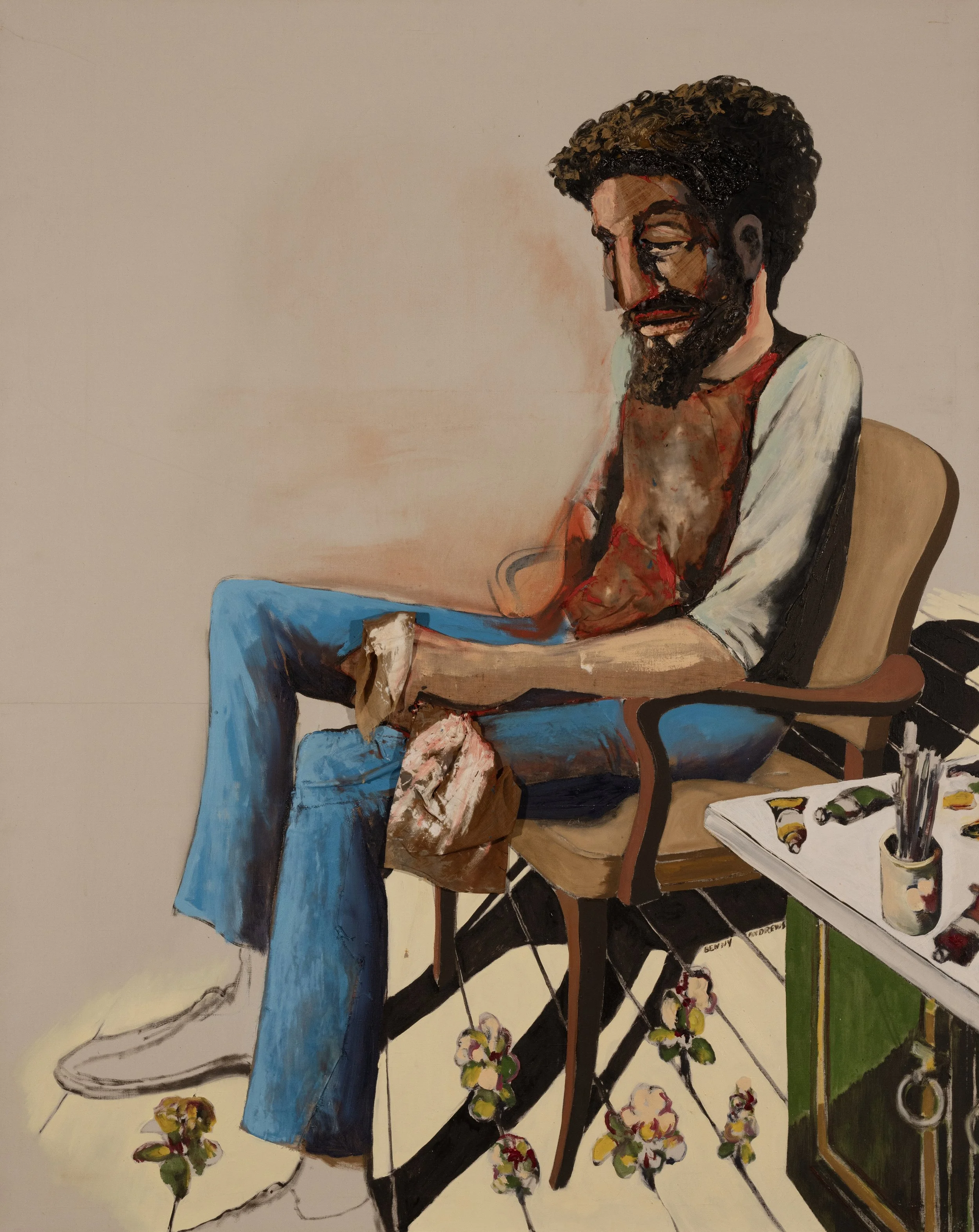
December 1970 - Edge of Reality
Andrews’s painted his self-portrait, Edge of Reality, during the same weeks that he painted No More Games in December 1970. In it, Andrews’ body appears to be overcome by exhaustion, his eyes are low, and his shadow stretches across a hard wooden floor, aligning with his surrealist style. Paint brushes and paint tubes sit atop a green cabinet on the right side of the canvas.
Like many of Andrews’ other works, Edge of Reality is set in a surreal liminal space. He uses sandy tones and deep shadows that imply intense light, almost like a desert haze against the figure’s stretched angular limbs. The figure’s facial features are built up by thick paint and mixed materials intensifying the somber tone of the piece. Flowers sprout from the floor boards, the only identifiable special detail; the setting is defined only in the right corner of the canvas, while the rest of the piece extends into nothingness. The emptiness surrounding Andrews plays into the overall introspection of Edge of Reality. Similar elements from Edge of Reality were included in No More Games like the surreal setting of liminal space, the flowers sprouting out of the ground, as well as stillness and emptiness within the figures; while Edge of Reality is a self portrait, both paintings have similar thematic structures.
By 1970, Andrews had taken on many leading roles, facing the heat of public opinion and experiencing racial discrimination as a Black artist. He was an artist, professor, co-founder of the BECC, and activist fighting against institutional discrimination within mainstream museums. We can infer that Edge of Reality was an accumulation of these experiences. The self-portrait peeks into the private life of a true crusader, sitting quietly in a rare moment of rest and reflection.
1970 and 1971 - “The Damn Article”
“The Damn Article” centers on the negotiations between the BECC and the Whitney from 1969 to 1971, detailing administrative actions, meetings, and Andrews’ point of view. Following a 1968 protest against the Whitney’s exhibition, 1930s Painting and Sculpture in America, in which Black artists were unacknowledged, and the BECC’s 1969 protest of the Met’s Harlem on My Mind exhibition, the BECC negotiated with the Whitney Museum administration and board members to discuss the inclusion of Black artists and curators in future exhibitions and the museum’s collection.
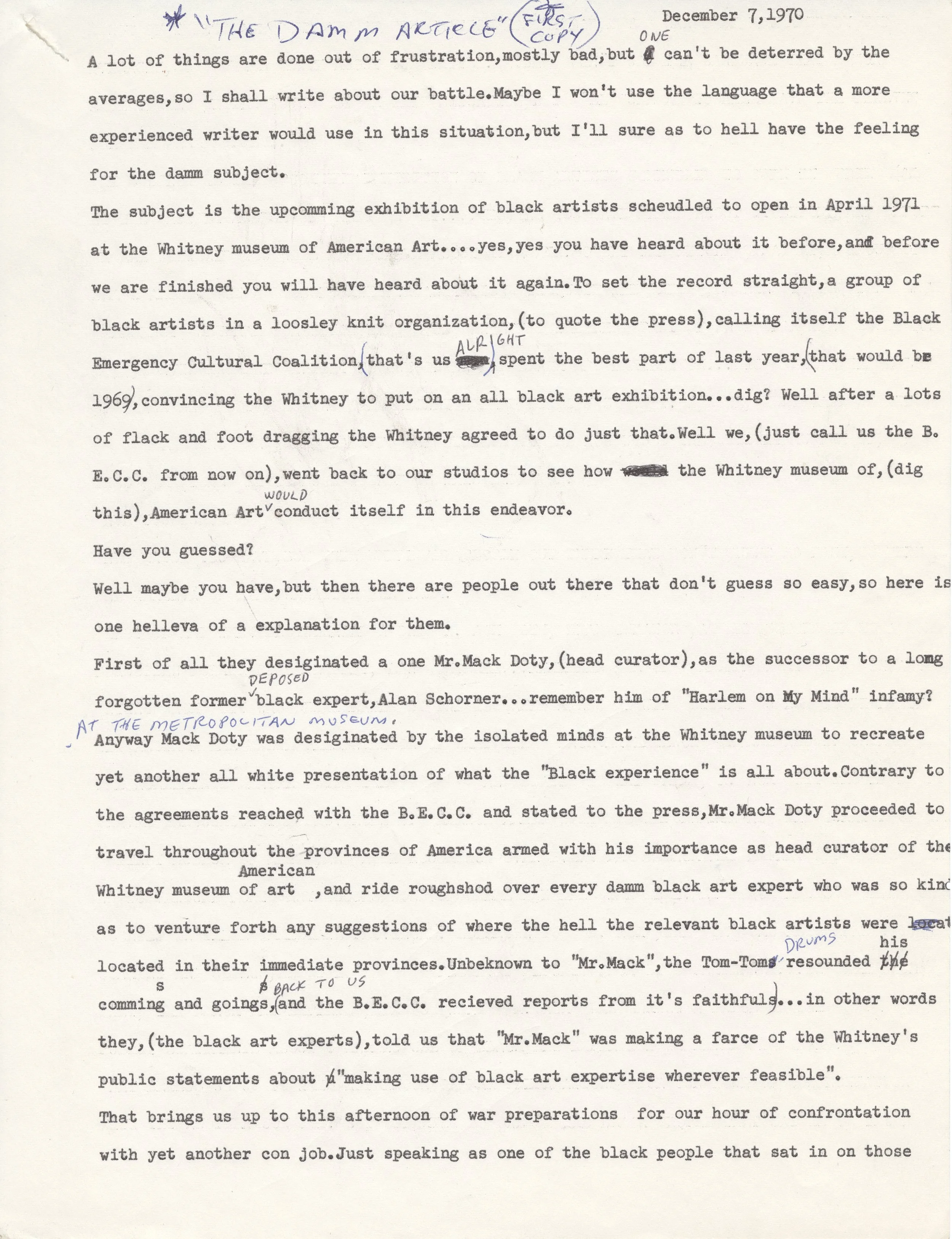
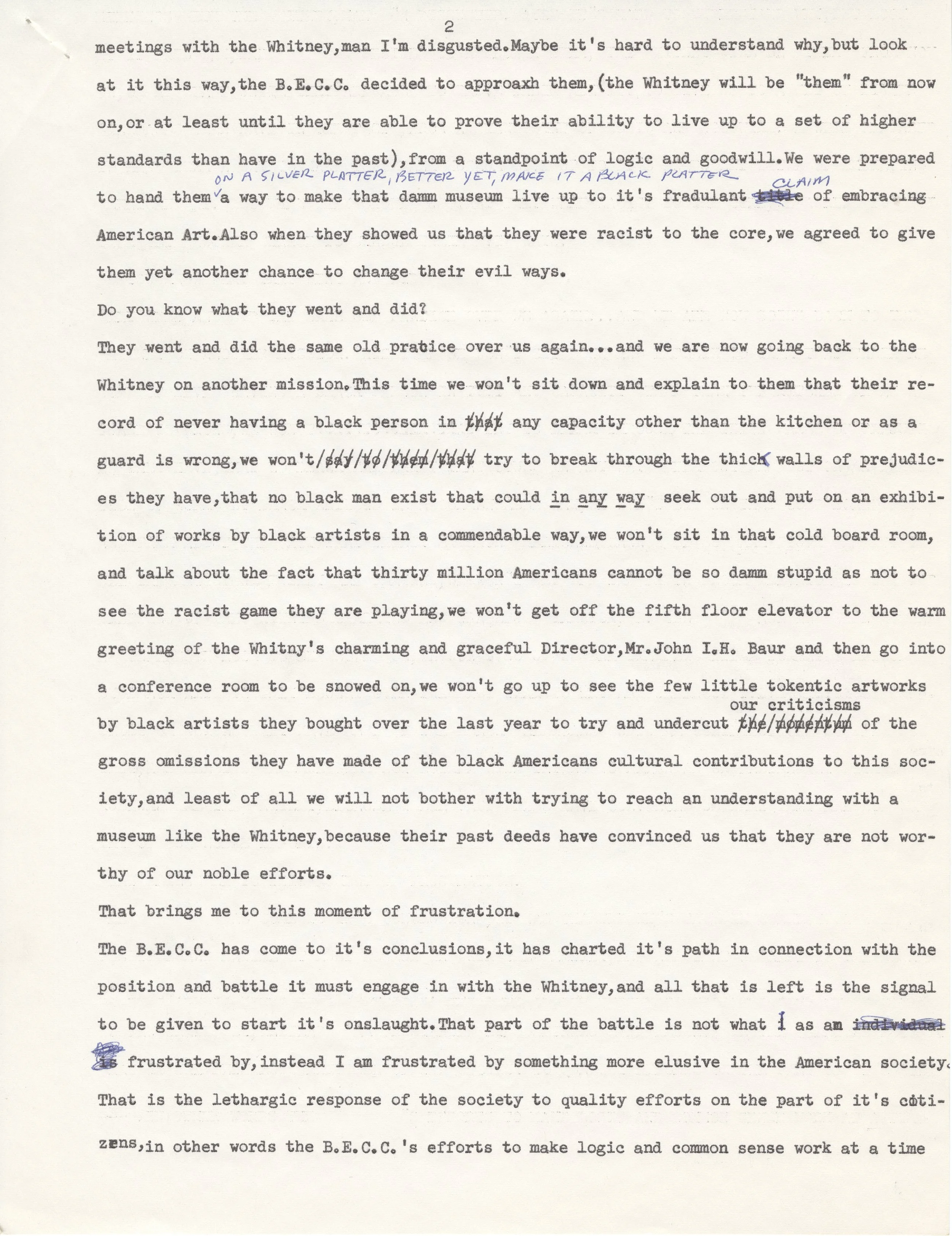
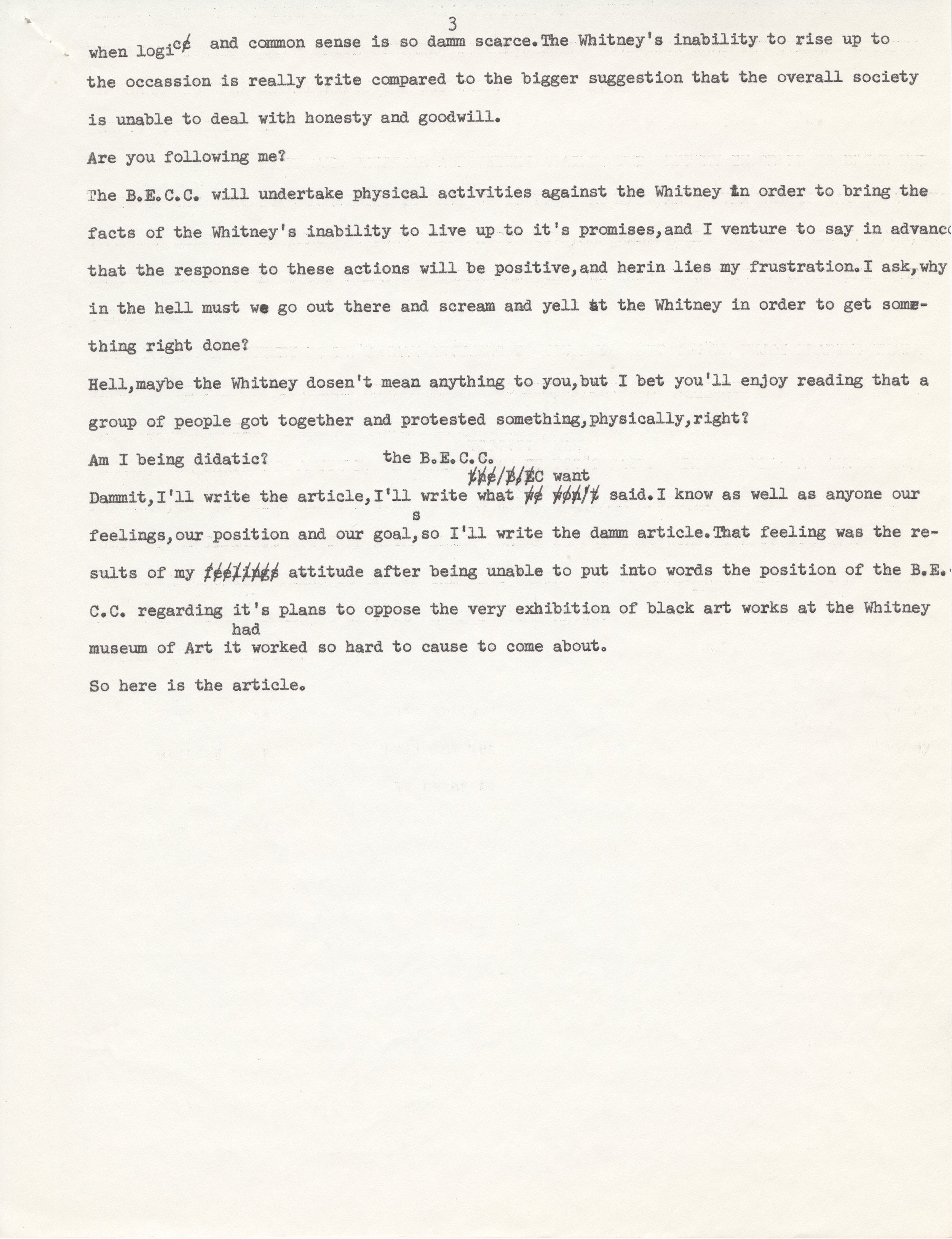
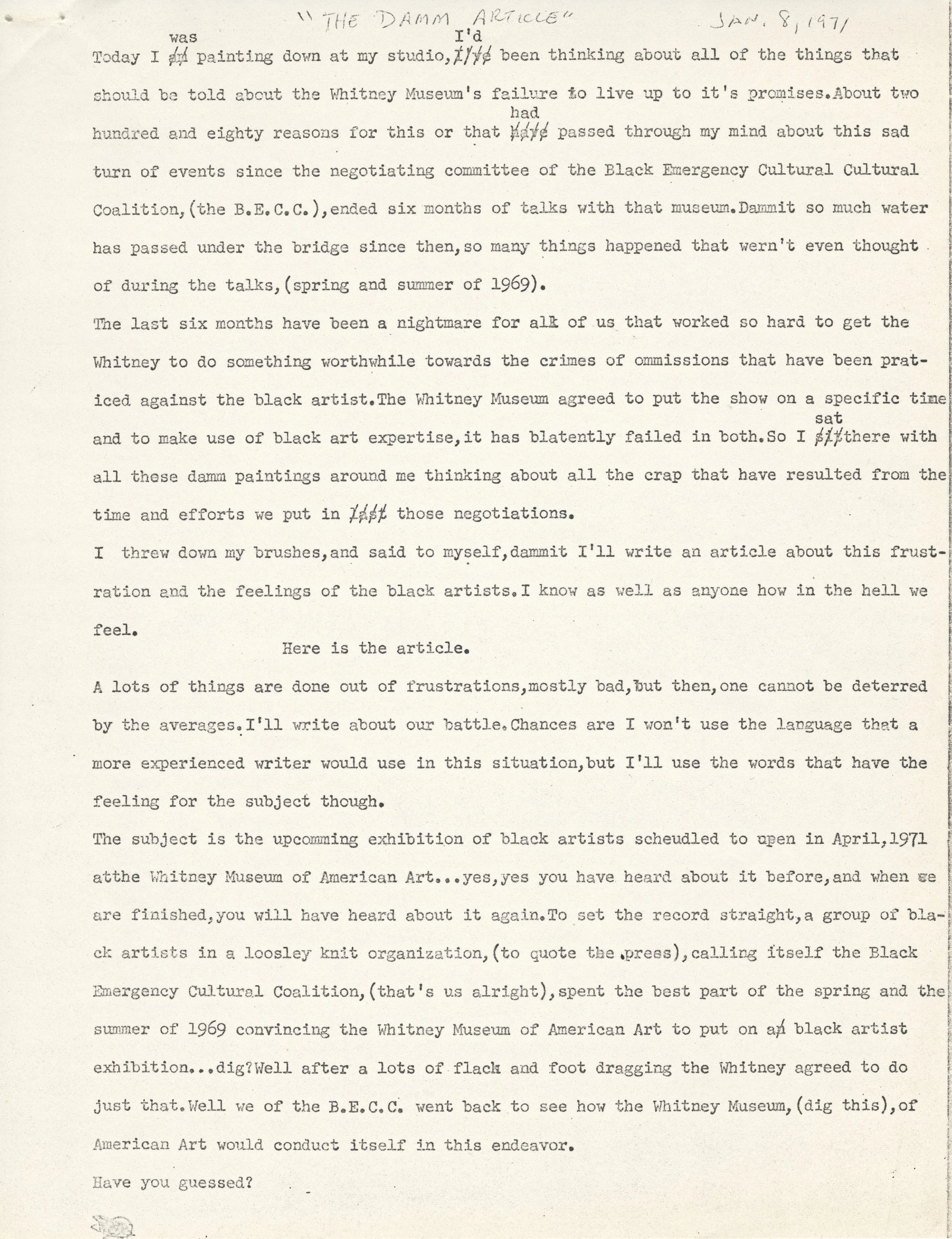
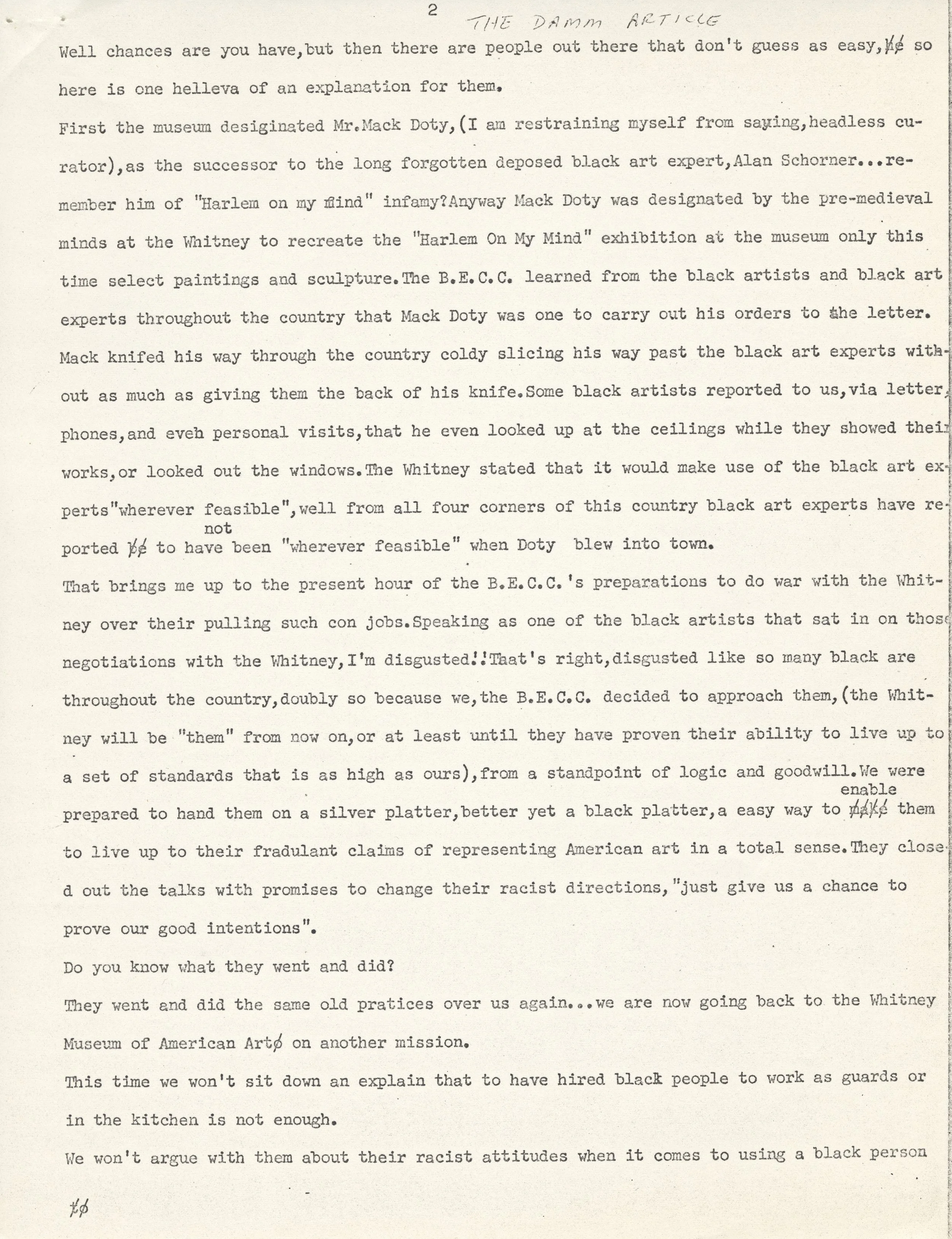
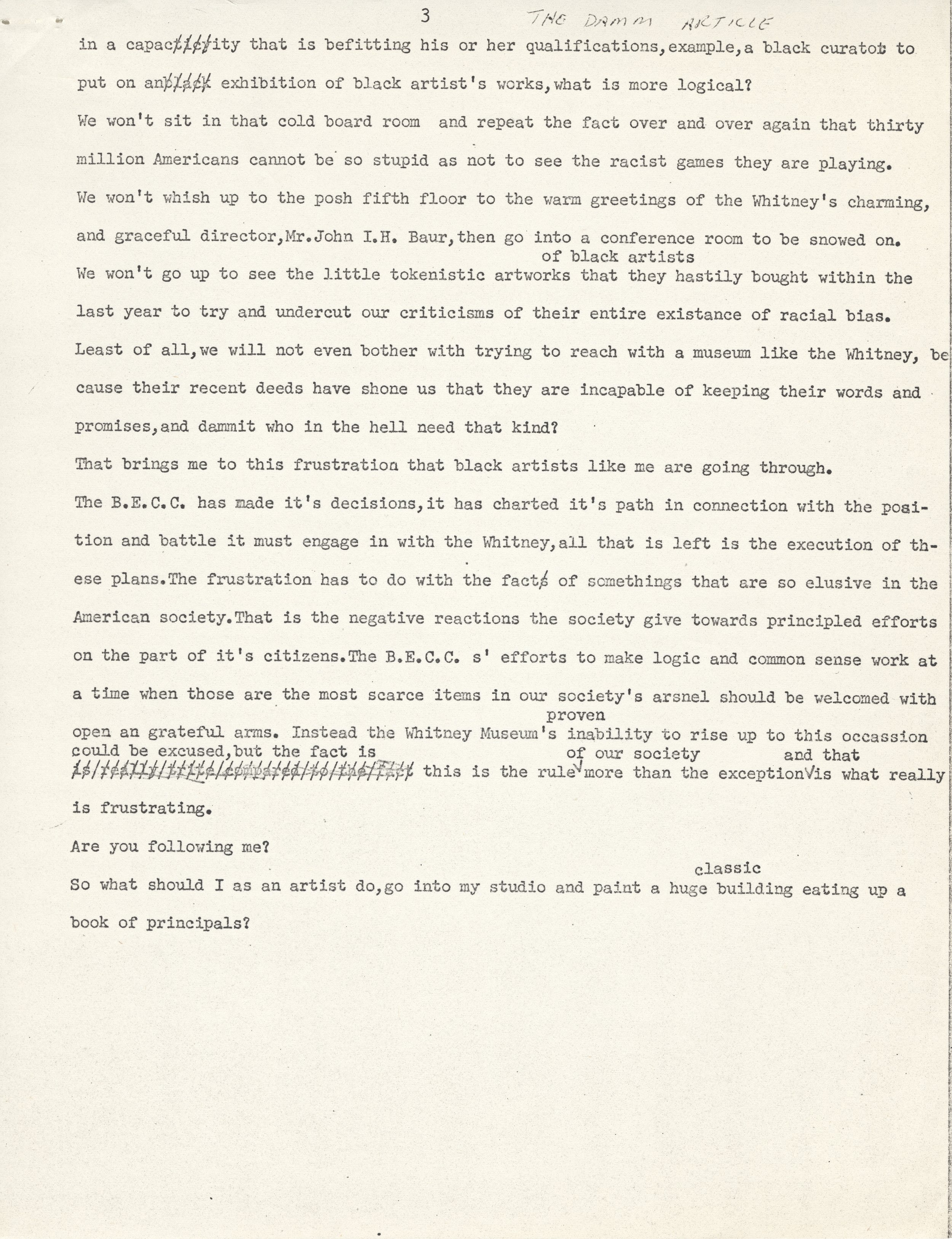
The Whitney agreed to put on a show of Black American artists at the BECC’s request, the outcome of these meetings being Contemporary Black Artists in America in 1971. The BECC drafted a list of conditions for the exhibition that included having a Black curator and Black advisors overseeing collection acquisitions. Although The Whitney agreed to most of these demands, these promises weren’t met and, as a result, misrepresented the voice of many impactful Black artists of the time.
Andrews’s first draft of “The Damn Article” was written December 7, 1970, around the time he was developing No More Games and Edge of Reality. The closeness in timeline leaves room to wonder if this experience was a point of inspiration for Andrews. The visual narratives in Edge of Reality and No More Games evoke an inner and outer dichotomy, Edge of Reality can be interpreted as a moment of silence, a vulnerable moment of exhaustion after long and stressful events such as what Andrews recounts in “The Damn Article.” Likewise, the bold and abrasive imagery in No More Games can be viewed as a commanding voice calling for change and direction. A central passage of the essay, refined in a second draft dated January 8, 1971, echoes the title of Andrews’s painting:
…We are now going back to the Whitney Museum of American Art on another mission.
This time, we won’t sit down and explain that to have hired black people to work as guards or in the kitchen is not enough.
We won’t argue with them about their racist attitudes when it comes to using a black person in a capacity that is befitting his or her qualifications, [for] example a black curator to put on an exhibition of black artist’s works, what is more logical?
We won’t sit in that cold board room and repeat that fact over and over again that thirty million Americans cannot be so stupid as not to see the racist games they are playing.
1971 Trash and The Bicentennial Series
Benny Andrews created the painting Trash, 1971, as a part of his “Bicentennial Series,” his reaction to the bicentennial anniversary celebrating the U.S. Declaration of Independence. Andrews anticipated the celebration would not include any mention of Black American achievement or culture. He dedicated six years to the project (1970-1975), working towards a single, monumental painting each year.

Trash is a large painting spanning across 12 canvases. Here, sexism, police brutality, political corruption, slavery, and more are all tie to the central narrative of American culture. These topics each employ their own visual narratives separated onto flat dolly platforms that descend into the background appearing as an endless train. Each platform is filled with elements of American symbolism like flags, football helmets, and Lady Liberty. Looking deeper into the piece, more sinister elements such as military officials, phallic characters, and Ku Klux Klan members reveal the underbelly of America as an institution that doesn’t offer freedom for all races or genders, and for some isn’t a nation to feel proud of.
The message of Trash and No More Games remain relevant to the present day. No More Games is a call for action and change, while the visual symbolism in Trash envisions that change in motion, a departure from a destitute perception of Black culture. In Trash, the visual metaphor of figures pulling American values that appear to be rooted in discrimination of class, gender, race, and nationality speaks volumes in the context of today; the painting forces us to recognize similarities between the 1970s and 2020s. Essentially, what has really changed if themes from the 1970s are able to accurately critique the here and now? Where do we draw the line?

Benny Andrews, No More Games (Study #2), 1970, 18 x 24 in. ink and pencil on paper, Collection of the Museum of Modern Art, New York, NY. (Inscription on recto: “Benny Andrews / Dec 2, 1970”)